Search This Blog

Monday, January 3, 2011

Overlord Part III: The preparations.

"In preparing for battle, I have found that plans are useless, but planning is indispensable."  Dwight David Eisenhower

Command:

When, in 1942 America’s untested troops stormed ashore in Algeria and Morocco, FDR had appointed Dwight David Eisenhower to lead them.   After some heavy negotiations, Roosevelt secured his leadership for Operation Torch, the Allied invasion of North Africa.  The US would lead the invasion, despite no real battle experience against the Germans yet as of November of 1942, because the initial target would be French North Africa.  The French colonies in North Africa, after the Fall of France were defended not by German units, but by the Vichy French.  The Allies were hoping that, despite the legal fiction of neutrality -- French troops were actually functioning at the pleasure of the German victors -- the Vichy troops would not put up much of a fight.  There had already been serious friction between the British and Vichy when the British, concerned that the Germans might get control of some ships of the French fleet, attacked the French Navy in Vichy waters, so the British were probably not the best choice.  The French capitulated quickly after tense negotiations, and the success of the operation led to Eisenhower’s rise to commander of the Supreme Headquarters, Allied Expeditionary Forces (SHAEF) in December 1943.  His next major assignment was the planning of Operation Overlord.


Eisenhower was chosen because he was a diplomat as much as a warrior.  He had the responsibility of balancing the tough egos of the top British and American and Free French commanders who were competing with each other to show the largest contributions to the Allied war effort.  He also needed to manage the inter-service rivalries of all of those forces: strategic air forces, tactical air forces, naval and ground forces of each of those countries would need to be coordinated in such a massive and complex invasion.  There was ethnocentrism and competing agendas as well.   American foreign policy was explicitly anti-colonial, a severe sore point with their allies.   The Free French and the British were defending empires upon which the sun was just beginning to set.  Furthermore, the French were very eager to show they could liberate their own country, and fought the lead taken by the Americans or British despite the fact that America provided almost all of their transportation, equipment and supplies and many of their forces were staying in England.  So the plans that were worked out required a delicate balancing act from their commander.
Eisenhower planning for Overlord, flanked on his right (our left) by General Bernard Montgomery, commander of the British ground forces, and left by British Air Marshal Arthur Tedder, who helped Eisenhower battle British and American strategic air force commanders who did not want to subordinate their air offensives to the invasion plans!  This was Eisenhower's hardest fight of them all!
 
The invasion itself looked like a long odds gamble to the Eisenhower because of several factors.  The first limitation was that the invasion could succeed if it took place where the Allies could control the air.  Air attack on the landings needed to be prevented, which meant that the Atlantic coast of France was pretty much the only choice.  Southern Brittany was lightly defended but far from British ports and airfields, and far from the eventual objectives -- Berlin and the Ruhr industrial center.  Belgium and Holland were close to these, but too vulnerable to German air and naval concentrations to risk an assault.  French beaches had a large tidal surge, so only certain beaches were suitable, and timing had to be chosen with great care so that landing craft could sail over German obstacles and not disgorge the troops in water too deep for them, or too far out from the beaches.  Men in the water would be slowed down and too vulnerable to enemy fire.  If they landed in water over their heads, they would sink and drown with their heavy packs. Weather would limit operations.  It would be impossible to go if the seas were too rough or the skies too windy or foggy for the effective use of allied air or sea power.  A full moon was needed for airdropping the parachute divisions.  Germany had fortified the beaches with concrete pillboxes and artillery emplacements, mines, barbed wire and a host of obstacles.  And the Allies would only be able land a small percentage of their forces assembled in Britain in the first wave.  The Germans would have 58 divisions on or near the coast; the Allies would be able to land only eight.  The odds against success were pretty long -- unless the Germans could be prevented from quickly concentrating 58 against 8!  

Eisenhower's plan:  German Dispositions and Allied plans for the Battle of Normandy.  The crucial German panzer divisions are in dark red.  German units with an empty rectangles are fortress troops, those with an 'X' are regular infantry.  Pas de Calais is not marked, but is the area immediately east of Dover full of fortress troops, and targeted for an Allied diversion.  Those green areas in Germany were objectives of the British and American strategic bombing offensive that Ike needed to divert to destroy the French transportation system in preparation for the invasion.

Logistics:

Once the troops were ashore, they would require supplies.  Soldiers could only carry the food and ammunition they needed to fight a full effectiveness for two or three days, and much less than that if operations were going to be as intense and prolonged as could be expected.  The invading troops would be pitted against some of Germany’s best military units.  The Germans would have the use of the full French road and rail nets to supply their troops, and they had had years to create supply depots and fortifications to help support their troops.  The invading forces would have to carry everything on their backs initially.  For this reason, the Allies put a very high priority on quickly seizing a good deep water port and there were only a few really good ones along the entire French coast.  While the Allied troops weighed these factors in arriving at a plan, the Germans were also looking at them, trying to predict where their enemy would strike, and they were fully aware of the Allied supply challenges.  The best ports would be heavily defended.

Technological Innovations:

Nowhere is the story of Allied inventiveness more deeply validated than in the devising the technological solutions that made amphibious assault possible.  In all of World War II, as complicated and risky as these operations were, I know of only two failures.  The critical one was a raid on Dieppe on the coast of France in 1942.  This raid cost 3,000 Canadians their lives when they landed on well-defended beaches without the engineering capabilities to quickly overcome the German fortifications.  Despite the severe sacrifice, Dieppe taught the British many valuable lessons about conducting amphibious assaults.  To avoid this vulnerability, they invented machines that could protect them:  “Hobart’s funnies,” tanks that were designed to clear mines and barbed wire, tanks that were armed with flamethrowers, tanks with huge mortars for destroying enemy field fortifications, tanks that could swim ashore on their own power, and armored bulldozers that could help to carry on the work of assault engineers more safely under enemy fire, clearing obstacles on the beaches.  Assault engineers had the unenviable job of clearing all these defenses so that the infantry could get to the enemy.  The British also greatly expanded the role of naval gunfire support and redesigned their tactical air arm so that troops could get more support on the beaches in response to the weaknesses in these arms discovered at Dieppe.  All of these innovations would serve to make D-Day’s beach landing more successful than that at  Dieppe.  

Three examples of Hobart's Funnies in a contemporary museum.  On the left is a Sherman tank fitted out with a dual drive system so it could swim under its own power to the beach.  The middle vehicle is like a DUKW, or 'duck'.  It is a boat until it hits the beach, and then it acts as an armored cat.  The right-hand vehicle is designed to thrash the  ground with the chains on that roller so as to clear a path through minefields.
The Americans had already developed effective landing craft that could reliably bring troops ashore on beaches.  These were called Higgins’ boats, named for their inventor, Andrew Higgins of New Orleans, Louisiana.  (Higgins adapted designs for swamp boats used on the bayous where it was necessary to have very shallow draughts:  A boat that goes too deep into the water gets hung up on lots of obstacles in the swamp.  So, landing craft benefited from riding very high in the water. There is an entire museum devoted to this story in New Orleans that is worth visiting if this topic is of interest).  In 1944, landing craft were a critical bottleneck in the Allied war effort, as these tended to get expended in great numbers in every invasion.  While Operation Overlord was the top priority of the Allies in 1944, landing craft were needed everywhere, including for an invasion of the French Mediterranean coast planned for early August of 1944, and in the Pacific, where they were the mainstay of every US island assault.

Troops disembark from a Higgins boat.  By the time of the Overlord invasion, the Allies had specialty craft for landing tanks, vehicles and supplies, but Higgin's boats were the mainstays of infantry landings.


The Allies had almost three million troops allocated for deployment to the invasion of France, but would only be able to land 160,000 in the initial assault.  After that they would have to build up their forces as quickly as possible. Despite generally adequate shipping, this would prove a very challenging task.  Troops not only needed to be transported, but supplied with every item needed to sustain offensive operations.  Supplies had to be stockpiled in Britain and then loaded and shipped to France, and then would need to be unpacked and distributed to the troops.  Allied innovations include “Mulberries” the code name for a plan to transform the landing beaches into serviceable port facilities; and PLUTO, an underwater pipeline for pumping fuel from Britain to Normandy.  These would begin deployment the moment the landing beaches were secured.

One of the Mulberry pier-heads before it was sunk in position on the beach.  Mulberry components all had to be floated across the English Channel, and then sunk at the Arromanches or Omaha Beach landing sites.
A rare aerial photo of the Omaha Beach Mulberry.  This photo was taken June 12, 1944, just 6 days after troops hit the beach, and a week before the facility was destroyed in a storm.  The Arromanches Mulberry survived the Normandy Campaign, but much of it was later cannibalized when better ports were captured and made operational.

German Defenses:

The Germans had left a sizable occupation force in France after their victory in 1940, and after the Dieppe Raid, they expanded it.  Hitler and Goebbels would brag in radio addresses of the invulnerability of Festung Europa (Fortress Europe), and Germany did devote considerable resources to protecting the French Coast.  On the other hand, in the light of a possible Allied invasion, ensuring the security of French borders was a significant challenge.   In an inspection in 1943 Erwin Rommel realized that although the French ports were well fortified, the beaches were not.  Rommel himself was put in charge of upgrading the defenses.  He found everything he needed -- from troops to concrete, guns, land mines and barbed wire -- were in shorter supply than his requirements due to the immense demands of support for the Eastern Front.  While Rommel’s fifty-eight divisions would greatly outnumber any initial Allied force that could assault the beaches, Rommel didn’t know where they would attack.  He had to defend a 500-mile-long coast because the Allies could land almost anywhere, given their control of the sea and the skies.  Rommel also had to deal with the variability of the quality of the available troops.  These divisions ranged from full strength panzer divisions -- units armed with Germany’s best tanks and crack troops, to fortress garrisons comprised of partially disabled war veterans, under-aged and over-aged soldiers, and ‘Ost’ battalions of captured Poles and Russians who preferred military service to being worked to death in the concentration camps of Eastern Europe.  Many of these troops might not fight effectively in battle.

Field Marshal Erwin Rommel inspecting Festung Europa.  In 1943, it was mostly Nazi propaganda.
Rommel also faced the difficult choice of whether to put his best units -- the armored divisions -- on the beaches or hold them in reserve.  He knew that if he could arrange to meet an Allied attack on the beaches with his heaviest firepower, his forces could crush the landings at the outset.  The problem was that, if he proved incorrect in his guess about where the landings would take place, those top units would be stationed on the wrong beaches and would take longer to move into position to attack those Allied soldiers who made it to shore.  In the end, the decision was taken from Rommel’s hands by Hitler and the High Command, who ordered that the armored formations would be kept in reserve.  Hitler reserved to himself the decision about when to release some of the panzer divisions.  Ironically, this meant that Eisenhower, who would be coordinating the forces of many different nations, would have a unified command and full authority to commit his forces.  Rommel, who commanded only German forces in France, would not have the authority to commit some of his best troops.

Battery Lindeman, which shelled Dover from near Calais.  These made great propaganda photos for the home front, but Rommel had too few massive forts like these, and too much coastline to cover. 
Which Beaches?

The Allies believed that two best locations for the Allied assault on France were the Pas de Calais and Normandy.  The ‘better’ of these, Pas de Calais -- immediately across the Straits of Dover from England -- had many advantages.  It was the most direct route to Germany, closer to the campaign objectives.  It was also at the narrowest point in the English Channel, making the shortest possible trip from English ports to France, and it would be easier to defend from any possible interference by German submarines or patrol craft in the narrower waters.  It was already east of several formidable defensive barriers the Germans could use in their defenses, including the Seine Valley we are sailing now.    The area also held the promise of opening up a number of excellent ports, including Dieppe, Dunkirk and Calais itself, although the Allies did have reliable intelligence suggesting that these were heavily defended.

The other good choice was Normandy.  It was less heavily defended, was relatively easy to cover by air, was close to the major port of Cherbourg,  which might be quickily taken, thereby helping the Allies supply their troops.  Normandy was farther away from the German border, and that might mean that if the Allies could get reinforcements quickly to Normandy, perhaps they could defeat a portion of the German army there before all of the Germans mobile forces could be concentrated.  In their final analysis, invading Normandy seemed to the Allies the best way to prevent 58 from being brought to bear on 8.

The Key Solutions I:  Strategic Air Interdiction

The Allies launched two successful campaigns prior to the invasion that greatly aided in overcoming the German’s initial numerical advantage.  The first was a strategic bombing campaign that targeted bridges, ferries and river transport, railways, railroad marshaling yards, and all manner of transportation resources.  The purpose of this was to inhibit the German’s ability to quickly concentrate their forces in France.  Moving armored divisions by actually driving tanks down the road was slow, inefficient, caused lots of wear on the tanks, and was very hard on the roads.  So anything that made them more difficult to load and transport would mean that the tank divisions would arrive with more broken tanks before the battle on the ground even started and expose them to Allied air attacks as they came to the battle.  This bombing campaign resulted in the destruction of hundreds of bridges, and today you can see the beautiful brand new ones France needed to build after World War II to replace those destroyed in this campaign.  But the bombings also resulted in ‘collateral’ French casualties and damage to other buildings and  to cultural sites.  We saw evidence of this bombing campaign that still remains over 50 years afterward.  But the bombing did have another significant impact: it cleared the skies of Luftwaffe defensive forces.  When the invasion came, enemy fighters and bombers would scarcely make an appearance, because German losses had dictated the withdrawal of such forces for the defense of Germany itself.

 The pre-invasion bombing from the German point of view!


The Key Solutions II:  Psychological Operations:

The second was a campaign of disinformation meant to ‘sell’ the Germans on the idea that the Allies would invade the Pas de Calais.  The intelligence campaign used deception and misdirection including:  planting false papers on the corpse of an Allied officer which implied a Pas de Calais invasion site, then arranging for his body to wash up on the coast of France; withholding General George Patton -- America’s best tank commander, who Germans may well think would be central in any invasion – from the Overlord operation and assigning him to a phantom army poised to invade Pas de Calais.  Fake units, complete with fake barracks and vehicles and phony communications signals were assigned to Patton’s ‘command.’  British intelligence had cracked Germany’s Enigma code system, and German communications using this decryption device were monitored for signs that the Germans were taking the bait.  The Allied bombers left several radar sites in Pas de Calais untouched immediately before the invasion, and on the date of the genuine landings, a fleet of ships was sent to be picked up by this radar to keep the deception convincing right up to the moment the troops were assaulting the Normandy beaches. 
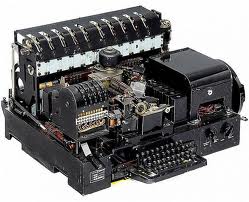
An Enigma machine used to encode secret German radio transmissions.  The capture and decoding of one of these was the Allies' most closely guarded intelligence success of World War II.  In the Normandy Campaign it was mainly used to see if the Germans remained convinced of a Pas de Calais invasion.
This disinformation campaign was very successful, and managed to convince many in the German High Command, including Hitler, that Pas de Calais was the indeed the target.  And that conclusion was probably confirmed for Hitler when his astrologer read the same prediction in the stars!   Hitler was slow to allow the movement of troops from Pas de Calais, for that reason, and the Germans thought for several weeks after the troops had landed that the Normandy invasion was only a diversionary attack.  They were, in fact, so convinced of this that when the invasion occurred, the Pas de Calais ports were so heavily defended that some of them held out until the very end of the war, and important German mobile formations were withheld from the Normandy battle altogether.

The Allied Assault Plan:

The plan called for a beach landing of the assault elements of 5 infantry divisions, two American, two British, and one Canadian.  The three Commonwealth divisions would each be reinforced by a tank brigade, including those fancy vehicles meant to help clear the beach defenses.  The largest air drop yet planned in the war -- two American parachute divisions and one British -- would land on the flanks of the beach to disrupt any efforts the Germans might make to reinforce their defenses on the beaches themselves.  In the critical first hours of the invasion, the Allies could project only 160,000 men against an unknown number of potential defenders.  Everything would depend on getting ashore quickly and then off the beaches to push the defenders back so that the Germans could not shell the landing sites with artillery as reinforcement and supplies were brought in.  

The final Allied plan.  Note that Cherbourg, the good port, is at the end of a peninsula and the US 4th Infantry Division does not need to advance very far to the west to isolate it!  The city of Caen on the east would be easy to defend from German counterattacks, if the British and Canadians can seize it quickly.

Weather:

Of all the variables that Eisenhower could plan for but could not control, the weather was the critical wild card.  There were only brief windows each month in which the moon was full so that airborne forces could see to be dropped properly, and the tide was high enough to clear the German obstacles on the beaches so that the landing craft could get close enough to give the assaulting soldiers the best chances of success.  The first window in May of 1944 came and went:  the Allies were not ready and the weather was too unpredictable to take the risk.  The next chance would come June 5-7, and another would follow June 19-20.  The sooner the Allies could go, the more time they would have in the best campaigning conditions before rain and snow slowed operations in the autumn and winter.  But rain and high winds or choppy seas during these invasion opportunities would make the landings too risky.  The longer the Allies waited, the more opportunity the Germans had to bolster their defenses, and the greater the risk that Allied security would fail and the Germans might correctly assess the landing location.  Allied intelligence thought the Germans were unaware that Normandy was the chosen site, but they couldn’t know for sure whether the Germans appeared to be focusing on Pas de Calais because they were buying the false clues – or because they were engaged in their own disinformation campaign.  If the Germans put their primary strength in the sites where the Allies planned their landings, the Allied invasion was doomed.

The Sum of All Fears:

With all preparations made, the best guess of the Allied High Command was that the assaulting units would take 20% casualties, but 40% was not beyond the realm of real possibility.  In other words, the invasion was expected to cost the Allies as much as 60,000 dead and wounded on the first day.  Furthermore, Allied leaders knew that losses that high could cripple the ability of the remaining troops to function effectively.  They were perfectly aware that most military units ceased to be effective fighting forces when casualties reached that level.  They were betting that the impossibility of retreat would mean that these units would keep fighting, but that assumption was unproven.  

The fate of the three divisions being parachuted on the flanks of the beach was also a concern.   Parachute divisions were elite, highly trained troops but might have to bear the brunt of the counterattacks by veteran German armored units and would not have heavy weaponry to fight them off for very long.   They could only be lightly armed and there was no way to get the tanks, heavy artillery or anti-tank weapons they might need to them by airdrop.   This too was a gamble; there could be no guarantees beyond what solid preparation might provide.  It is easy to appreciate the crushing sense of responsibility Eisenhower felt having to make the command decision to launch the invasion with these expectations.  The deaths of up to 60,000 men gambled against the possibility that the Germans would realize that Normandy was the target site and fortify and garrison it in time to crush the invasion. When the time came to make the call, he would be able to poll the commanders immediately beneath him, but the ultimate authority was his.
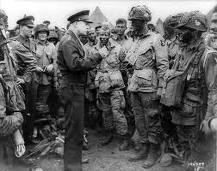
Eisenhower reviewing American paratroops immediately before Operation Overlord.

Tuesday, December 7, 2010

Overlord II: Allied Strategy in World War II


So the obvious answer to the question, “Why invade France?” is that France fell and could not free herself unaided.  But, in addition to that, a host of other geopolitical and military considerations made the invasion of France inevitable.  This essay will explore some of these other reasons and attempt to put the invasion in context.

The military considerations that, at first, delayed plans to liberate France, began to change.  In the first 12 months of 1940-41 immediately following the Fall of France, it was all Britain could do to stay in the war.  After thwarting invasion of the British Isles in the autumn of 1940 by prevailing in the Battle of Britain, the United Kingdom would be locked in her central struggle of World War II:   the Battle of the Atlantic – Britain’s struggle to keep shipping lanes open and import the supplies and war material it needed to keep fighting against Germany’s submarine campaign to isolate them.  The British would lose 2400 merchant ships during the war and 30,000 sailors, most in 1940-43. Prior to December 7, 1941 when the Japanese attack on Pearl Harbor ended American neutrality, the British government had no serious plan for the liberation of France.  

U-Boat pens in St. Loirent, France.  It was stated in a previous post that capturing the French coastline allowed the Germans to extend the range of their fleet.  This is one of the places U-boats were armed, fueled and repaired.  The Allies attempted to destroy these by strategic bombing, with little success.


In June of 1941, Germany launched a surprise attack on their former ally, the Soviet Union.  This time, they would use deliberate and formal blitzkrieg tactics on the Russians in their massive invasion plan, Fall Barbarossa.  (That’s right, the plan was named after the same Fredrick Barbarossa who we talked about in a previous blog post – the Holy Roman Emperor who joined with Richard I and Philip II for the Third Crusade and drowned in Anatolia on the way, causing his huge army to lose heart and go home).  By December, 1941, the Germans were able to  destroy hundreds of Russian divisions en route to the gates of Moscow.  But, the exigencies of war were changing.  Even as the Japanese aircraft carriers that had raided America’s naval base at Pearl Harbor returned to spearhead a wave of Japanese conquests in the Pacific, winter descended on Russia.  Joseph Stalin, certain now that the Japanese would not attack Russia, pulled his reserves from the Far East and unleashed them on the ill-prepared Germans during the worst winter in 100 years.  The German attack stalled just short of Moscow, and the German Army, sent into a battle that was expected to conclude by September, faced -40°F temperatures without winter coats.  Diesel fuel turned to sludge at 40° below, immobilizing German vehicles.  By spring, the Germans had been forced back from the gates of Moscow, and had been handed their first serious check on land.  With the Germans deeply committed in Russia, and the US in the war, the Allies needed to devise a strategy for winning it.

A German Panzer IIIC set to advance on Moscow in October of 1941.  As in The Battle of France in 1940, in 1941 German tanks were not superior to Russian equipment, but were more effectively employed.  Russian preparedness in 1941 was adversely affected by Stalin having sacked many military commanders in a 1939-40 purge under the mistaken impression that they were a greater danger to his rule than the Germans.

Even before these events were well underway, Winston Churchill sailed to Newfoundland in August of 1941, and later to Washington for meetings with Franklin Delano Roosevelt.  By January 14, 1942, the basic blueprint of Anglo-American cooperation had been hammered out at the ARCADIA conference.  Chief among these plans was agreement between the two leaders and their general staffs that the European Theater would be given top priority to the Allied resources.  While the United States (and Britain) was precipitously involved in wars on two fronts after December 7, it agreed with Winston Churchill that the events in the European Theater were the most dangerous and required the most immediate response.   They could agree that Germany -- and Italy, which had formally joined the Axis Powers as France collapsed -- would be fought first.  But there was less agreement on how this was to be accomplished. 

The Americans favored a direct approach; invading France at the earliest possible moment.  The British, who had had far more experience fighting the German Army and had to consider the protection of their colonial assets, advocated a series of more limited attacks on the periphery.  Before a serious direct challenge to Germany could be mounted, America needed to raise a much larger army, train and equip it, build and deploy its air forces, and use its navy to clear the Atlantic Ocean of German submarines so  it could safely supply and transport troops in Europe.  Despite America’s enormous industrial potential and a steady gearing up to supply Britain and Russia, on December 7, 1941, its army ranked 19th in the world, immediately below that of Bulgaria!  It would be two years before the weight of US troops and materiel gave them the leverage to persuade the British to invade France.  In the interim, limited operations were undertaken in North Africa, then Sicily, and finally against mainland Italy, knocking Italy out of the war.  This slow entry into the European war gave the Americans valuable battle experience and improved both the British and American capacity in undertaking amphibious operations.   On the other hand, these campaigns and direct attacks on Germany by American and British heavy bombers had still done little to blunt Germany’s military power or will to fight.  By mid 1943, Germany continued to hold the majority of its territorial gains in Russia, and had lost only North Africa and the southern boot of Italy to the Western Allies.  Stalin was militating for a more forceful military response from Britain and the US, complaining that he was bearing almost all of the weight of the war.  And, in this he was largely correct.

An American War Poster Propagandizing US Production.  America out-produced the entire Axis powers (Germany, Italy, Japan, and their minor allies) in every category of arms that mattered.  The US also supplied the Allies with 90% of their oil!


In the West, the untold story of World War II is that the Soviets did most of the fighting and most of the dying in the European Theater.  As crucial as the upcoming Overlord Operation would be, it was far from the decisive battle against Germany, a picture accounts of the Western Allies sometimes like to suggest. 

What was truly the decisive battle occurred in the late autumn of 1942 at the city of Stalingrad.  For after Germany had stalled just west of Moscow in the winter of 1942, the Germans lacked the military power for an all-out offensive against Russia across the 1000-mile front when the weather improved for the summer campaigning season.  Hitler, realizing that Germany lacked the oil reserves for a protracted war, decided instead to focus his forces on an offensive in Southern Russia aimed at capturing the Russian oil fields in the Caucasus. (Hitler has been severely criticized for mistaken interference in German military strategy.  This is an egregious example; Germany never had the slightest hope of capturing Russian oil fields intact and bringing significant petroleum back to Germany for refining, even had they been captured.  The trackless steppe between the Caucasus oil fields and Berlin lacked the infrastructure to move significant amounts of oil back to Western Europe.)  

German Vehicles roll across the steppes in the summer of 1942 in the execution of Fall Blau

Fall Blau (Case Blue) opened promisingly for the Germans with initial defeats for the Soviets in Southern Russia.  German armored spearheads plunged deep into the Caucuses, bypassing the un-garrisoned city of Stalingrad in early July.  Later it was decided Stalingrad needed to be taken to protect the flank of this main attack to the southeast.  Had Hitler made this decision earlier, he could have seized Stalingrad when it was scarcely defended.  But by August of 1942, the Russians had reinforced it, and the Germans would need to clear this city block by block.  The German attempt to do just that would become the dramatic symbol of the entire struggle between fascism and Bolshevism.  This was World War II’s battle equivalent to Verdun.  By November, the Germans had been bled white, but had indeed occupied 90% of the city and suburbs by concentrating their best troops there.  Then the Russians launched a blitzkrieg of their own, attacking on the steppes north and south of the city now defended by weak Romanian, Hungarian and Italian troops.  They quickly punched through these and surrounded and isolated almost a quarter of the entire German Army on the Eastern Front in the city of Stalingrad.  When a hastily organized relief attempt failed to reach the city, Hitler ordered the surrounded army not to attempt a simultaneous break out but, instead, to hold at all costs.  An ill-conceived effort was made by the Luftwaffe to supply the defenders entirely from the air.  The isolated defenders clung tenaciously to the ruins of the city as further Soviet offensives threatened to cut off an even larger German army now retreating all the way from the Caucasus.  Eventually, the retreating Caucasus army was saved, but when the last surviving German troops surrendered in February of 1943 at Stalingrad, the Russians had destroyed an army of a quarter of a million men.  This was the decisive battle of World War II.  Russia had destroyed enough experienced German troops that the Germans could no longer assume the strategic offensive and could no longer hope to overcome the Soviet Union by conquest.  And it demonstrated that the Red Army had mastered the basic skills of offensive warfare, and could effectively use the tactics of armored warfare to recover their country. It was an entirely Soviet operation -- and a nearly miraculous recovery -- given that Germany had overrun about 40% of the population and industrial centers of the Soviet Union in the immediate previous 16 months.  

Stalingrad on the Volga River can be seen in the background encircled by Soviet troops in early 1943.

All through 1943, and the first half of 1944, the Soviets would be clawing back their territory from the Germans. In July of 1943, the Germans had reorganized their tank forces and launched their last major offensive on the Eastern Front with the limited objective of reducing a salient in the front.  The Russians were able to inflict a decisive defeat on the Germans, in part, because they were able to learn precisely where the Germans would attack and extensively fortified their lines.  The Battle of Kursk would include the largest tank battle in history and permanently secure the strategic initiative for the Soviets. By 1944 on D-Day, they had taken back most of Russia and the Ukraine through a series of offensives in which the Soviets assembled a predominance of force, pulverized a limited portion of the front with artillery, and then sent their tank formations through the lines, penetrating 60-70 miles, and hanging on for the inevitable German counter attacks.  While these actions were invariably more costly to the Russians than the Germans, they paid off in by allowing the Russians to recover their lost territory.  

Soviet Troops and heavy tanks advance in a 1943 propaganda photograph.  Note the strategically placed collective farm in the background.  It would be unlike the Germans to have left it intact!


In some ways, the campaign on the Eastern Front was like a different war, fought with a desperate ferocity – on both sides -- that made the operations in the West seem pale by comparison.  Early in campaign, the Russians, for example, transported all the industrial machinery they had to the Urals and left only the shells of factories for the Nazis to loot.  In addition, they practiced “scorched earth”  as they retreated in the face of German attacks, laying waste to their own countryside to prevent the Germans from using their resources against them.  Showing similar viciousness, the Germans entered Russian cities, they shot anyone thought to be a Communist Party official and deported millions of able-bodied civilians for forced labor in factories in Germany and Poland.  They also organized specialist military units for the purposes of exterminating parts of the civilian population.  The Germans did not just invade Russia, they laid waste to it and depopulated it.  When the tide turned in the East and the Soviets started to retake their lost territory, the Germans in their turn laid waste to the land again.  Similarly, rape and wholesale attacks on civilian refugees would characterize the Red Army’s advance into German territory.  The Russians fought not just to win, but to punish the Germans so severely they would fear to ever attack Russia again.

In Russia, World War II came to be known as the Great Patriotic War.  It was understood as a struggle for the very existence of Russia as a country, not just for the current communist government, and that is what it was.  At no time did Hitler have less that 66% of his divisions arrayed against the Russians and in 1942 and parts of 1943, that figure was closer to 75%.  In the final weeks of the war, German military units would dissolve and attempt to flee to the west so as to surrender to the Western Allies and thereby  escape Soviet retribution.  Russian casualties in World War II would be staggering; literally creating a lost generation.  Estimates of Soviet military casualties range between 6.8 and 11 million dead, with the Russians themselves claiming 8,668,000.  Forty per cent of their territory was overrun, and western estimates of Soviet civilian deaths range from 14 to 28 millions.  Russian official figures are 13,684,000, but the totals are controversial and the actual numbers may never be certain.  All of these from a population in 1941 of just short of 200 million; the Soviets experienced about 22 million deaths -- about 11%.  Compare this to 600,000 French deaths throughout the entire war, and 65,000 deaths and about a million prisoners forced into slave labor in Germany for the duration of the war stemming from the 1940 defeat.  (The other losses were Free French, Resistance, and Vichy losses in subsequent campaigns.)  American deaths on both fronts of World War II are about 400,000.  The British Commonwealth (including India, Canada, South Africa, Australia and New Zealand) lost about 650,000.  Germany would lose 3.2 million combatants and about 3.8 million civilians out of a prewar population of 80 million.

So the second major reason why the invasion of France made sense was there was a military opportunity (with Hitler changing his focus from West to East) and because our ally, Russia, needed a way to draw some of Hitler’s resources back to the West.  Stalin  demanded the help, and our relations with our Soviet allies required it.  By the time Overlord entered the planning stage, Churchill, Stalin and Roosevelt had already agreed that no separate peace would be negotiated, but the Western Allies needed to shoulder a bigger share of the fighting to ensure that promise was kept.  The Allies, primarily the United States, provided billions of dollars in aid, including planes, vehicles, and strategic materials.  But the Soviets built the large majority of their own equipment, and organized their own forces, and conducted their own operations with little coordination with Allied forces.

A third reason why the invasion of France was necessary involved the Free French Army and its leader Charles De Gaulle.  While this army fought in North Africa and Italy, the Free French ardently wanted to fight to liberate their homeland.  The French never stopped pressing their demands for liberation and a key role in the fighting for their country.

Charles De Gaulle was a daring French armor commander during the Battle of France.  He became head of the Free French Forces and went on to become President of France after World War II.  The Free French were sensitive about their role in their country's liberation, and the Allies were often perceived as high-handed.  France would become difficult ally in the Cold War that followed hard on the heels of World War II.  Here he strikes a characteristically cooperative pose!


One more reason was a result of German tenacity and the efficiency of German arms.  They left atrocities behind them in their governance of their occupied territories, and the insistence of the Allies on “Unconditional Surrender” meant that the war was going to need to be brought to the German homeland.  Finally, an invasion of France was made necessary because all the other imaginable routes for destroying the German’s ability to wage war had been tried and proved insufficient to conclude it.  No serious peace feelers had been received by the Allies by mid-1944, so for the war to be taken to the German heartland, France was the only practicable remaining route.

A German fortified naval gun, part of the Atlantic Wall the Allies would need to assault to liberate France.
 
By 1944, the peripheral operations had been tried, the German submarines had been largely dealt with, and the forces were being assembled in Britain for the largest amphibious invasion of all time.   The Allies were coming, the Germans knew it, and they were in the process of fortifying the entire Atlantic coast.  Next, we will look at the preparations and tactical decisions about Operation Overlord itself that set up that great gamble for success.
American-made M-4 Sherman tanks assembled in Britain as a tiny part of the huge build up of men and material that would be required for Operation Overlord.

Sunday, November 21, 2010

Overlord Part I: The Fall of France

“It is well that war is so terrible, or we should grow too fond of it.”  General Robert E. Lee, Confederate States of America
 
Robert E. Lee (1807-1870)  Lee is much beloved for his fight for States rights, and his moral leadership.  It is too bad his cause also included human slavery and the States' entitlement to seize Federal property by force!  His introspective comment is cautionary for all us, however.

On the second day of our Seine cruise, we stop in Rouen.  Rouen is the capital of Normandy, and a minor port on the Atlantic Ocean.  We will spend two days there, but the first is the piece de resistance, a major reason for our selection of this trip.  On our first day in Rouen, we are going to take buses to the U S Military Cemetery in Coleville-sur-Mer on the bluffs overlooking Omaha Beach.  Our subject will be the Allied invasion of Normandy in 1944 during World War II, code named “Operation Overlord”. 

No modern American battle had been as romanticized as this crucial Overlord invasion.  Perhaps you have seen the very realistic depiction of the initial assault at the beginning of Saving Private Ryan, a 1994 masterpiece created by Steven Spielberg from the popular historical accounts written by Stephen Ambrose on the occasion of the invasion’s 50th anniversary.  In this, Spielberg treats warfare with the same close eye for detail as Flaubert did French 19th century country life, loving and criticizing it at the same time.  The shocking hand-held camera work of the initial invasion sequence stands in great contrast to the lionization of warfare in most Hollywood depictions.  In an earlier movie, The Longest Day, the story line, adapted from Cornelius Ryan’s account of the first 24 hours of battle, is well conceived, but the combat is less realistically portrayed.  We have seen the movies and read the books and we will be treading familiar ground.  We, like General Lee, will look down from the commanding heights of the Norman coast and marvel at the grandeur and terror that organized human conflict represents.  For Lee was in a very similar position to the Germans, with his men in a naturally fortified position as his enemies struggled up hill to take Marye’s Heights in the battle of Fredericksburg, in December of 1862, which is when he uttered those famous words.  He would shortly prevail in the most lopsided major battle ever fought on American soil.  When we win, the temptation to romance is enormous, for General Lee, and for all of us.

Confederate artillerymen defending Marye's Heights during the Battle of Fredericksburg.  With a commanding view of the battle, Lee see it all unfold before him and realize the Union's assault on his positions was hopeless.
Captain Miller (Tom Hanks) reconnoiters a machine gun nest in an effort to get off Omaha Beach in the opening sequence of Saving Private Ryan.
 
The D-Day invasion is sometimes described as the turning point of World War II and sometimes as the most crucial battle in World War II.  It is neither, and these claims in part reflect similar romanticism.   But, when it was planned and launched, it was considered to be an incredible gamble, and that fear had everything to do with why it was a success.   And even if Operation Overlord was far more likely to succeed than was generally perceived at the time, it took tremendous courage and fully dedicated genius to ensure that success.  Had Operation Overlord failed, the world would surely look different from the world we know today.  Had it failed, the Soviets might well have overrun much of Europe, increasing their power in subsequent years.   Germany would probably not be free, democratic and unified today.  The American sacrifice on Omaha Beach was indeed critical to the struggle to preserve democratic values in Europe throughout the Cold War and sanctifies this part of Normandy.  So we will be treading hallowed ground; as at Gettysburg, “The brave men, living and dead, who struggled here, have consecrated it, far above our poor power to add or detract.”
A detail from the famous photograph of Abraham Lincoln (center) arriving in Gettysburg to deliver a short address in the rain on another crucial American battlefield.  That brief speech was sharply criticized at the time as being so short as to be irreverent.  He shared the platform with the foremost orator of his age, Edward Everett.  No one remembers Everett's Gettysburg speech, but he is remembered for writing to Lincoln the next day: "I should be glad if I could flatter myself that I came as near to the central idea of the occasion, in two hours, as you did in two minutes."
What made the invasion of Normandy so critical?  There are a number of answers.  But the dramatic story of the Fall of France deserves a better telling than the superficial one we encountered in the Musèe d’Armèe back in Paris, so we will explore that in detail before turning to some of the other important answers that shaped Allied grand strategy in World War II to be covered in the next post.

Actually, the Battle of France was also critical in the struggle to preserve democratic values in Europe, but France was singularly unsuccessful in defending herself when threatened with invasion in 1940.  This shocking failure made a cross-channel invasion in 1944 essential to the Allies' war plans.  Love democracy as we might, there is little to love in the story of the Fall of France.  But if there are powerful lessons about French and American experience to be drawn from the Norman coast, there are also important things to learn in France’s collapse.  For in those dark days of the late spring and early summer of 1940, it seemed that the foundation ideals of freedom and democracy were failing altogether.

You may recall from my post on Churchill’s bunker that France succumbed very rapidly to the German invasion in 1940.  Despite 22 years to prepare for the rematch necessitated by the Treaty of Versailles, France was woefully under-prepared for the military realities of World War II.   So understanding the Fall of France in 1940 requires some understanding of how the Germans succeeded and the French failed to take advantage of this inter-war period.  The roots of this lesson lie in how the great stalemate on the Western Front in World War I was overcome.

The Signing of the Treaty of Versailles by William Orpen.  The treaty was executed June 28, 1919, in the Hall of Mirrors.  The Germans would occupy Versailles in just less than 21 years.  Starting third from the left are British Prime Minister David Lloyd George, American President Woodrow Wilson, and French Prime Minister Georges Clemenceau.  The provisions of the treaty would come to be considered unfair, and contribute to France's paralysis in the face of rising German militarism in the 1930's.

When the combatants in World War I all charged off enthusiastically to battle in 1914, neither the citizens nor their leadership realized how completely the bloody stalemate and war of attrition that resulted would end the Europe they knew.  Almost everyone anticipated a quick and glorious decisive battle to demonstrate the superiority of their own arms.  But no such battle would happen in World War I due to the unanticipated consequences of two key technological innovations and a problem of doctrine which everyone shared.  After a 2 month fluid period in 1914 as the Allied and German military machines first came to grips with each other, World War I’s showcase front was a costly stalemate because the military theories of the time, which essentially held that whichever side had the greater élan or will to win would prevail, had been outstripped by technology.  

French Heavy Cavalry parading through Paris on the way to the front, August, 1914.  No better exemplars of elan, and its uselessness, could be found than cavalry, which proved obsolete the moment they charged into battle on the Western Front.
In retrospect, the doctrine of élan itself seems extravagantly romantic; that our manly soldiers are so much more resolute in their love of country that they will prevail over our enemies on the battlefield in a pure test of moral superiority.  These ideas have been around for a long time, and are far from stamped out today.   But they were very prevalent in 1914, and would face the severest trial by fire when confronted with the unanticipated consequences of technological change.

A British Vickers machine gun.  This one is not very well dug in, easy pickings for a heavy artillery bombardment!
The first key technology was the machine gun, and it rendered battlefield élan obsolete.  Machine guns were bulky, heavy, and needed to be mounted stably on the ground to fire efficiently; most required two men to operate, one to load belts of ammo and the other to aim and fire.  But if a two man crew could keep a properly sited machine gun operational and if they were fully equipped with ammunition, they could kill an essentially unlimited number of adversaries.  When pitted against such a machine gun, the higher morale of the advancing enemies, the longer the machine gun could keep mowing them down.  Machine guns could fire faster than men could advance.  Stories of a single machine gun killing 600-800 adversaries in a few minutes were not uncommon on the Western Front in World War I.

Because assaults on enemy strong points occupied by machine guns were so arduous and costly, military doctrine dictated vigorous shelling of enemy strong points with artillery before assaulting them.  The goal was to destroy all the enemy machine guns so your troops could come to grips with the enemy infantry in their trenches where the mass of your assault could overwhelm their defense.  Instead, massive bombardments blasted the earth into mud pockmarked with giant craters, and motivated the enemy to dig ever deeper to avoid destruction from the rain of artillery shells.  The result was trench warfare.  Both the Germans and the Allies built a continuous line of trenches, often fortifying a zone several miles back from the front lines, from the Swiss border to the English channel starting in October of 1914.  As the war dragged on, these fortifications became ever deeper and more elaborate.

An aerial photograph of a small portion of the German Trenches on the Western Front.  Trench living was miserable, boring, terrifying and squalid in turns
The second technology was the railroad, and railroads had been used in war for over 50 years when World War I broke out.  But their implications for creating a costly stalemate were not fully realized until trench warfare became widespread.  Because railroads behind these trench limes made it easy for the enemy to shift troops, there was almost no chance that a determined force could advance through the morass of mud, craters, barbed wire and obstacles, and unreduced enemy strong points before their adversaries were reinforced with fresh troops rushed to the threatened sector of the front by rail.  For these reasons, the Western front scarcely moved twenty square miles on a 400 mile front that stretched from Switzerland to the lowlands of Belgium for three full years.  A terrible war of attrition ensued.  During offensives, it was not unheard of for 60,000 men to become casualties in a single day.  The Battle of Verdun described below would kill 140,000 Germans and 160,000 Frenchmen, and wound half a million over ten months of 1916 and that is just a single battle!  A horrible caricature of élan developed in which entire countries became locked in struggle, fighting until their national wills and economies broke under fire.  No one, victor or vanquished in World War I said anything like General Lee’s Fredericksburg quote.  Armies mutinied, economies collapsed, citizens lost faith in their leadership, and dynasties fell.

German troops travel by rail during World War I.  All sides had dedicated troop trains, but accommodations were not always comfortable.  It is likely these fellows had to get off a few stops short of the Paris destination scrawled on the side of the box car.


A World War I tank, right?  Not exactly!. This is actually a highly modified tractor chassis made to look like a British Mark VIII tank by the tech wizards of Indiana Jones and the Lost Crusade!  Do not judge them too harshly, there are very few operational tanks surviving from that era, and they were mostly modifications of existing vehicles hastily jury-rigged and rushed to the front.  The turret was added because it looks cool.  Mark VIII's didn't have them, but tank turrets were a World War I innovation.  Trouble spotting the enemy was a chronic problem for World War I tankers, and even for armored knights.
To break this bloody stalemate, two key innovations were developed.  The first was a new technology: the “tank”, a motorized vehicle machine gun strong point that was armored so that it could not be harmed by  opponent's machine gun fire.  (“Tanks” were so named by the British, who referred to them as water carriers in the development process to disguise their true purposes from German intelligence!)  The Allies invented tanks first, and found it hard to control groups of them or keep them from breaking down on the battlefield.  They were complicated, balky and newfangled.  But eventually, tanks would be used to break though the deep and complex series of obstacles that comprised trench warfare.  


This two minute silent video shows British and French tanks in action in 1918.  Note that early tanks had no suspension systems, so tankers were rattled around like they were being shaken in a tin can.  Armor was thin, and 'spalling' -- splinters of the tanks' armor, often flew around inside the tanks when they were hit, injuring the crew.  Engine exhaust vented inside the tank, often sickening them.

If tanks represented the technological solution, the Germans were the first to hit upon a change in doctrine.  They asked: ‘What if, instead of assaulting the strongest points in the enemy’s line, one bypassed them?’  Rather than allowing the entire force to be stopped by the toughest enemy position on the line, just move out of range and go around it.  Wouldn’t the enemy eventually become afraid, stop firing and fall back, thus allowing friendly forces to advance?  And if not, perhaps they could be assaulted from the rear!  As the war progressed the Germans trained whole divisions of Stosstrupen schooled in these infiltration tactics.

Stosstruppen advancing on the Western Front in 1918.  Note that their machine gun takes three men just to carry.
The Germans field tested this solution on their Eastern Front against the Russians, and fanned the embers of the Russian Revolution into open flames with defeats they handed the Russian Army.  In 1917, the Russians dropped out of the war.  Also in 1917, they used these tactics in the Caporetto Offensive against the Italians; infiltration almost knocked the Italians out of the war.   In the spring of 1918, they employed them on the largest scale yet, and briefly broke open the Western Front for the first time in three years.  While this admirably validated the theory, the Germans ran out of momentum and troops short of capturing Paris and ending the war.  Five months later, exhausted, and facing fresh American manpower to augment the depleted French and British, the Germans appealed for the armistice that ended World War I.

In the interwar years, an elite set of military theorists, led by B H Liddel Hart and J F C Fuller, suggested that infiltration tactics and armored fighting vehicles could be combined.  The massed firepower of tanks could punch a whole in enemy lines, and then their mobility might allow them to penetrate deep into his undefended rear areas where they could overrun headquarters, seize enemy transportation centers, cities and production facilities, and surround and isolate frontline units on a scale much larger than anything accomplished during the Great War.  Convinced by experience of the value of infiltration tactics, Germany designed and organized an army that might be able to test this theory.  France built the Maginot Line, the most complex and sophisticated trench system the world had yet seen.  They would defend against infiltration by trying to become impossible to penetrate or bypass.

France had drawn a very different conclusion from her experience in World War I.  For the French, the defining moment of World War I occurred during the Battle of Verdun.  There, waves of conventional German attackers assaulted the forts surrounding the city of Verdun.  French national prestige hung in the balance as waves of German attackers assaulted these forts using conventional tactics. Robert Nivelle, the local commander, decreed “Vous ne les laisserez pas passer, mes comerades!” (“You will not let them pass, my comrades!) which has come down to popular history as “They shall not pass!” and he threw reinforcements into the meat grinder until he made good on this declaration. Verdun remained in French hands.  Eventually the French recovered part of French territory taken by the Germans in their initial assault.  After the war, the French took the lesson of this defining moment in a war of attrition to mean that they needed a more thorough-going defense in depth.  So in the interwar years they built a fort that extended every meter of the border between France and Germany, and Luxembourg, for good measure!  It was the biggest and longest military fortification since the Great Wall of China!  Only boggy ground and the need to repay World War I loans to the United States prevented France from extending this super fortification all the way to the English Channel.  The expense of the Maginot Line inevitably left France with less to spend on its conventional forces. When the Second World War came finally came, the Germans simply went around it, attacking just north of it through eastern Belgium.

Before and after aerial photos of Fort Douaument, the critical fort taken by the Germans in the Battle of Verdun.  The effects of prolonged artillery bombardment are clearly evident.  The French eventually recovered the remains of this fort, exhausting the French Army in the process.  In the next year, extensive portions of the French Army would mutiny, refusing to attack.

An artist's rendering of some of the extensive underground system of Maginot fortifications.

Preserved portions of the Maginot Line today.
In the interwar years, the Germans combined their lessons in infiltration tactics that almost won World War I for them with the power and mobility of tanks.  They designed their air force for ground attack and for sweeping enemy aircraft from the skies over the front lines.  When it was time for the armor to attempt a breakthrough, they would have the support of dive bombers.   In the blog post on the Battle of Britain, we saw that the Luftwaffe performed poorly as a strategic bombing force when the Germans needed to penetrate deep into enemy air space and bomb English industry and population centers.  But it was extremely effective in supporting the “blitzkrieg,” (lightening warfare) which is what this new method of warfare came to be called when the Germans overcame the Polish Army in less than one month in the Autumn of 1939.  In this opening battle of the war it became evident that, whatever World War II was going to be like, this first battle for Poland wasn’t anything like the Western Front in World War I had been.  

A Panzer 2D from the Poland invasion.  German tanks were a huge improvement over the World War I designs, but not better designed than those of France or Britain.  They were, however, employed much more effectively.
On May 10, 1940, The Germans initiated Fall Gelb (Plan Yellow), their operational plan for a preliminary invasion of Belgium and Holland, both of which had scrupulously remained neutral in hopes avoiding any involvement in the expected battle between the Allies and Germans.  The Germans never had any intention of making their primary assault on France through the Maginot fortifications.  The German plan was limited, a preliminary for coming to grips with the Allies in the ‘real’ battle to follow in northern France where the fortifications were lightest.  It made no provision for armored spearheads penetrating deep behind Allied lines.  The German High command never had any intention of making unsupported armored thrusts.  In many ways, Fall Gelb was a flawed operation; the Germans projected much of their armored force through the rough and heavily forested Ardennes.  This aided them in concealing their intentions, but resulted in a two-week long traffic jam as this was the one place in Western Europe the roads could not support the huge mechanized forces involved.   The plan could have turned out very badly had the Germans failed to achieve a breakthrough right at the point they emerged from the Ardennes.  If they had needed to redeploy up or down the Meuse River that constituted the region’s southwestern boundary, the terrain and roads would have poorly supported such a move.  But in operation, Fall Gelb worked far better than it had been drawn up in development.

The lead German units came out of the Ardennes May 13 in France near the town of Sedan, which was heavily fortified, but a pale shadow of the Maginot fortifications.  On paper, it was not a propitious place to attempt to force a major river crossing.  It was well garrisoned, albeit with second rate troops.  In two days, the Germans overcame French reserve units that did not put up a very spirited fight despite being fortified in good defensive positions.  The Luftwaffe performed well in its close support role, and did an excellent job of controlling the air space over the battlefield, breaking up air attacks on the Meuse bridges hastily organized when the Allies recognized their danger.  Some French units started to melt away, imagining that the Germans had already broken through and were behind them when nothing of the sort had yet happened.  The local French mobile forces were slow to counterattack, and in some cases they were destroyed in their camps, unprepared for the speed of the German breakthrough.  Command indecision paralyzed the French response at just the wrong moment.  For the French, everything that could go wrong did, and they made all the wrong choices.

Much of the credit for exploiting the breakthrough must go to local German commanders who exceeded their orders and in some cases were flatly insubordinate in advancing beyond the Fall Gelb’s guidelines.  Erwin Rommel, who would later distinguish himself in the African desert, was among the most successful and aggressive.  Heinz Guderian and Erich von Manstein would also distinguish themselves in this battle and later become famous commanders on the Easter Front when Hitler went on to invade Russia in 1941.  But having imagined the possibilities of armored spearheads in the French rear, these generals refused to be denied.  After two days of heavy fighting at Sedan, the German armored forces broke through the dissolving French lines completely, and raced behind the main French and British forces that were rushing to meet them in western Belgium.  On May 19th, despite many fears, breakdowns and misgivings, German armored units had advanced from Sedan to the English Channel, isolating the entire British Expeditionary Force and a dozen French divisions from the main force in France itself.  Churchill, having just been elected Prime Minister and after receiving a defeatist call from the French Prime Minister Paul Reynaud on May 15th, flew to Paris on the 17th  to confer with his French counterparts and heard them talking about already having lost the war despite the fact that the campaign was scarcely a week old!  He was dumbfounded to learn that the French had no strategic reserve:  the best French mobile units were all advancing north into Belgium with the British forces.

Erwin Rommel (1891-1944) was an audacious armor commander.  He would go on to great success in North Africa where his British opponents named him "The Desert Fox."  He would have partial command at Normandy when Overlord commenced, and was wounded during the battle when his staff car was strafed by Allied aircraft.  He was coerced into suicide in October 1944 for probably mistaken notions that he had participated in the July 20, 1944 bomb plot against Adolf Hitler.  Rommel is probably the most romanticized German commander in World War II.

The Germans, frightened by their own success, now lost their focus.  Their tanks were out of fuel and strung out across Northern France, and in many ways the German High Command was confused at having lost control of the battle.  Hitler now signed an order that slackened operations to catch their breath.  The British quickly realized that, with their forces oriented to the north and still advancing in Belgium, they had little chance of attacking through the German lines in the south to rejoin the main French army. Instead, they retreated to the coast.  A heroic evacuation, Operation Dynamo, centered on the French town of Dunkirk, was jury-rigged, pressing every available civilian water craft to help pull the troops back to England.  While the Germans resupplied, reorganized and dithered, the British withdrew almost 250,000 British soldiers and 100,000 French, albeit with the complete loss of their heavy equipment.  The evacuation was concluded June 5, and when the Germans were ready to resume their attacks on the Dunkirk perimeter, the British were gone and an immense opportunity had been lost.

Also on June 5th, the Germans resumed serious offensive operations aimed at capturing Paris, but the French, having already lost 25% of their forces and succumbed to defeatism, capitulated June 25th, 1940.  Many French units fought well.  The Germans launched a limited attack on the Maginot line, which had to be depleted of some of its defenders due to the French and British units withdrawn from France (the French no longer had enough troops to cover the front.  Although the French evacuees from Dunkirk were mostly repatriated, there was no time to re-equip and reorganize them into effective military formations).  The German attack proved that the fortifications were not invincible, and managed a small breach.  But the campaign was decided in the fields of northern France.  Hitler came to Paris and enjoyed the sights while passing out medals and parading the troops down Avenue Foch.   The French were forced to sign the instruments of this surrender in the same railroad car where the Germans had endured the humiliation of signing the armistice ending hostilities in World War I.  A rump French government, later termed ‘Vichy France’ would rule southern France while Germany occupied Paris, all of northern France and the Atlantic coast.  When the Allies invaded North Africa in November of 1942, the Germans shut down their French puppet and occupied all of France until of the summer of 1944 when the Allies started to liberate it.  Most of France’s extensive overseas colonial empire became neutral territory under the control of Vichy.  A few of the Dunkirk evacuees and a few minor colonies fought on as the Free French.

 BBC Animation of the Battle of France

The Fall of France shocked the world in its rapidity. The Germans had accomplished in 7 weeks what had eluded them for 4 years in World War I.  The campaign had immediate and far-ranging effects, even beyond the Battle of Britain already discussed.  The capture of major ports in southwestern France would greatly expand the effectiveness to the German submarine warfare by extending the range of their fleet.  They would have locations to rearm and resupply that were much closer to vital British shipping lanes, so the submarines would have more time to hunt and could sink more ships.  With France vanquished, Hitler would turn his attention east to the Soviet Union, and soon Italy, Romania, Hungary, and Bulgaria and would join the Axis Powers.  The neutralization of France’s North Africa territories would emboldened Benito Mussolini to widen the war there, and soon German forces would be needed to shore up Italian weakness in Africa and the Balkans.  The fall of France gave American President Franklin Delano Roosevelt the political leverage he needed to greatly expand American rearmament, and soon after, he pushed the Lend-Lease program through Congress, providing the US with the authorization to supply arms to the United Kingdom and later, the Soviet Union.  French weakness would also prompt Japan to seize French Indochina as a source of further leverage in their on-going war with China.  When the Japanese occupied Indochina, America imposed further economic sanctions on Japan intended make Japan withdraw from China, furthering the diplomatic escalation that the Japanese finally attempted to break with the attack on Pearl Harbor.  In this way, the fall of France led indirectly to American entry into World War II. 


A famous picture of the destroyer USS Shaw's bow exploding after being hit by a Japanese dive bomber during the attack in Pearl Harbor, December 7, 1941.  The Fall of France indirectly led to this attack.  Amazingly, the Shaw was repaired and served out the war in the Pacific theater.  The consequences of French weakness in Indochina would bedevil US foreign policy until the US itself withdrew from Vietnam in 1975.

The blitzkrieg that destroyed France in 1940 was not a careful script designed by the German General Staff and executed flawlessly according to plan.  The plan to invade France never had any doctrine that corresponded to the blitzkrieg we understand today. Rather, they built mechanized and air forces that could execute such tactics, and put leaders in charge who knew and understood the unproven theories, and who seized the initiative to make it happen. Both sides made mistakes, but the French mistakes were fatal.  The Germans beat a dispirited and demoralized French Republic that was equipped with the men and material to fight, but lacked the will to do so.  The French had the wrong plan.  But the Germans also caught a lucky break when the second rate troops at Sedan failed to fight well.  There might easily have been no breakthrough there to exploit.  But there was. Now it would be up to others to liberate France.  The question now was: “How to do that?”

But the rapid conquest of France had another effect.  With quick victories against Poland and France, Germany had shown that decisive battle was possible, and restored the romantic ideal that warfare, properly conducted, could easily and efficiently solve problems in international relations.  This notion would intoxicate Hitler’s ambitions and eventually doom Germany to a defeat far worse than it suffered in World War I.  But we are going to view the Normandy battlefield sharing a little of that belief, that this is the place where one of those decisive moments occurred when a battle really did change the world.  This may be a romantic idea, and a dangerous idea, but is nonetheless sometimes true.